
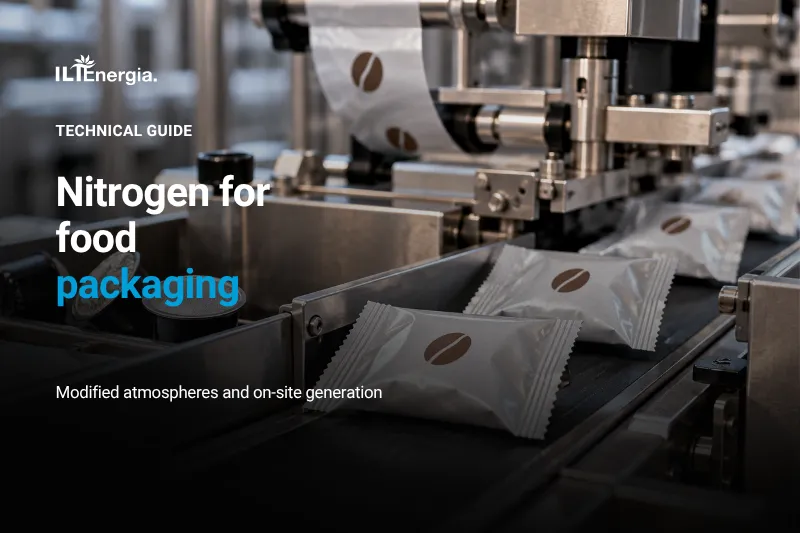
Nitrogen for food packaging is used to reduce oxygen inside a pack and limit oxidation. It is one of the gases used in modified atmosphere packaging, with different requirements depending on the food being packed.
For a packaging operation, there are two separate decisions: which atmosphere the product needs, and how to supply the packaging machine with suitable gas. On-site nitrogen generation addresses the second of these.
What is modified atmosphere packaging?
In modified atmosphere packaging, or MAP, the air inside a package is replaced or adjusted using a gas or gas mixture before sealing.
Unlike vacuum packaging, the aim is not simply to remove air. It is to establish a gas composition suited to the food, combined with packaging that provides the appropriate barrier properties and seal integrity.
Nitrogen, carbon dioxide and, in some applications, oxygen have different functions. There is no single gas mixture suitable for every product.
Why use nitrogen for food packaging?
Nitrogen is inert under normal packaging conditions. By displacing air, it reduces the food’s exposure to oxygen and helps slow oxidation, including the oxidative rancidity of fats.
It also has low solubility in water and fats. This allows it to help maintain pack volume, including in mixtures containing carbon dioxide, which may be absorbed by the food.
Nitrogen does not sterilise the product. Its role is to help establish the atmosphere required by the packaging process.
What are the benefits of modified atmospheres?
When the food, gas mixture and packaging are assessed together, modified atmosphere packaging can help preserve product characteristics and extend shelf life.
For products such as snacks, nuts and coffee, limiting oxidation helps protect quality and aroma. Dry foods also need protection from moisture: nitrogen does not replace the water-vapour barrier provided by the packaging material.
A longer shelf life can make distribution easier and help reduce waste. The achievable shelf life must be validated for the specific product, rather than inferred from a nitrogen percentage or a standard figure.
Nitrogen alone or as part of a gas mixture?
Nitrogen can be used on its own in certain applications or as part of a mixture.
Carbon dioxide can help inhibit the growth of some microorganisms. Oxygen, although it promotes oxidation in many foods, may be needed in specific applications, such as maintaining respiration in fresh produce.
The packaging atmosphere therefore needs to be specified and validated by the team responsible for the food process. Generating nitrogen on-site does not mean an existing gas mixture can automatically be replaced with nitrogen alone.
Gas quality and food safety
The nitrogen percentage alone does not define every gas-quality requirement. Potential contaminants, air treatment, materials, distribution, maintenance and the checks required by the food safety management system must also be considered.
The EIGA guide to on-site nitrogen generators for food use provides a technical reference for the design and operation of these systems.
Delivered gas purity and residual oxygen inside the sealed pack are different checks. The final result depends on the complete packaging process.
MAP does not replace hygiene, appropriate storage or the cold chain where required. Reducing oxygen does not prevent every microorganism from growing: hazard assessment and shelf-life validation remain essential.
Generating nitrogen for food packaging on-site
A PSA generator separates nitrogen from compressed air, making it available directly at the facility. On-site production can reduce reliance on deliveries and cylinder handling, particularly where demand is regular.
The economic assessment should compare the existing supply with investment, electricity, air treatment, maintenance and monitoring costs for the new installation. Savings are not automatic or identical for every business.
ILT Energia offers Nitro Series nitrogen generators, based on PSA technology. Food packaging is among the applications listed for the range; the suitability of the configuration must be checked against the requirements of the specific line.
What information is needed to size the generator?
Before selecting a system, gather the following information:
- gas specifications and the permitted residual oxygen level inside the pack
- average demand, peaks and the number of packaging machines operating simultaneously
- required pressure and operating hours
- compressed-air capacity and quality
- monitoring, maintenance and backup-supply requirements
Purity and flow rate must be considered together. In PSA systems, higher purity can reduce the available nitrogen flow and increase compressed-air demand. Read more in our guide to nitrogen purity and Nitro Series generator configuration.
A nitrogen source suited to your packaging line
Assessing on-site generation starts with the packaging machine’s demand and the requirements defined for the food and the gas.
Are you considering on-site nitrogen for food packaging? Contact ILT Energia with details of the product, consumption, pressure and gas-quality requirements. These are the starting points for assessing a Nitro Series configuration.