
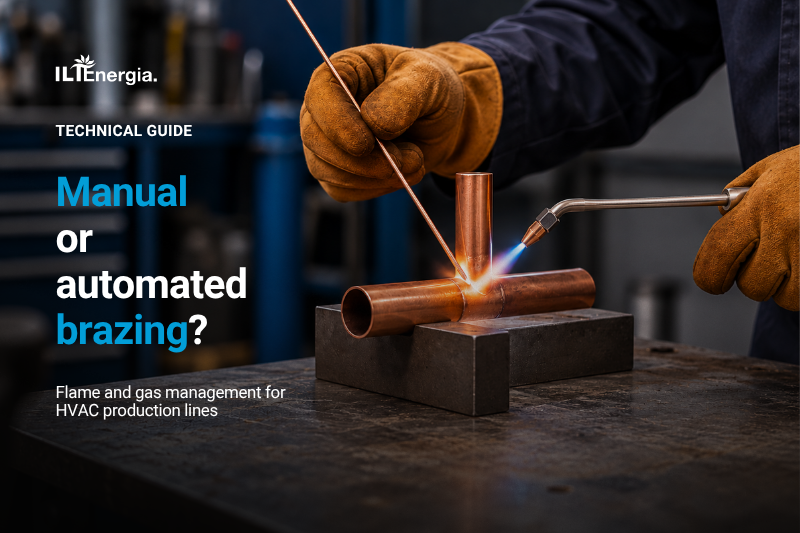
The choice between manual or automated brazing is directly relevant to manufacturers of chillers, heat pumps, condensers, evaporators and heat exchangers. On these lines, joints are made repeatedly on pipes and components, often across several workstations. The way work is carried out changes, as does the gas demand that needs to be managed.
This article focuses on flame brazing. Automation does not necessarily mean switching to induction: a torch-based process can also be automated, retaining a heat source supplied with fuel gas and an oxidising gas.
Manual brazing: control in the operator’s hands
In manual brazing, the operator controls torch movement and the addition of filler material, observing how the component heats up. Heat must be distributed across the joint with its geometry and the different masses being heated in mind.
This is where experience matters: not simply bringing the filler material to its melting point, but creating the conditions for it to flow correctly through the joint. Surface preparation, component fit-up and heating remain essential.
Manual brazing is therefore an option to consider when adaptability to different components and configurations is required. It should not automatically be regarded as less effective: process selection also depends on geometry, production volumes and product requirements.
Automated brazing: heating becomes a cycle
In automated brazing, component positioning, torch movement, heating times and the way filler material is applied are organised into a defined sequence.
The configuration may include stations with dedicated burners, rotary tables, in-line systems or robots. Semi-automatic solutions are also available, in which the operator loads the components and the machine performs the heating and cooling cycle.
Automation does not eliminate technical expertise: it translates that expertise into a repeatable process. Component preparation, positioning and cycle definition remain necessary even when the torch is no longer guided by hand.
Flame management: what needs to be controlled
How heat reaches the joint
It is not just the flame temperature that matters, but how heat is transferred to the components. Burner geometry, position relative to the workpiece and movement all affect heat distribution. A fitting and a pipe with different masses may require heat to be applied differently.
Processing times and sequence
In manual brazing, the operator controls the duration of heating during the operation. In an automated machine, times and movements must be defined for the specific configuration. Repeating the same cycle time alone does not guarantee that different components receive the heat they need.
Gas supply and regulation
The available flow rate and pressure must be compatible with the torch requirements. Regulation of the fuel gas and oxidising gas also contributes to flame characteristics: naming the gas alone is not enough to define how the system will behave. Operating conditions must be checked across the generator, distribution system and burner as a whole.
HVAC and refrigeration production lines
For an HVAC equipment manufacturer, the assessment concerns both the individual joint and the organisation of the line. In the manufacture of chillers, heat pumps, condensers, evaporators and heat exchangers, brazing can be carried out at manual, semi-automatic or automatic workstations, depending on the components and the organisation of the production line.
A hypothetical example helps illustrate the point: several manual workstations might operate at different times, while an automated station might activate several burners simultaneously. Even with the same daily consumption, the flow rate required at a particular moment could differ.
Sizing the gas source therefore requires an understanding of the usage profile and simultaneous demand, not just the total consumed during the shift. This is one of the criteria ILT uses to configure the system.
For further application context, read our article on hydrogen and oxygen in refrigeration.
Hydrogen and oxygen in flame brazing
Hydrogen and oxygen can supply a flame for brazing metal components. The European SAFEFLAME project studied this application on refrigeration components and pipework, among other applications, highlighting the importance of designing the burner around the required heating characteristics.
Switching from another fuel gas to H₂/O₂ should therefore not be treated as a simple change of supply: equipment compatibility and process conditions need to be checked. Results from a specific test cannot automatically be extended to every machine or joint.
We explore this topic further in our guide to brazing with hydrogen and oxygen.
The generator’s role in manual and automated lines
Elite Series hydrogen and oxygen generators produce the two gases separately through the electrolysis of demineralised water. ILT documentation includes their use in manual brazing and automated systems.
It is important to distinguish gas production from control of the brazing cycle. The generator makes H₂ and O₂ available; flame regulation, movements and operating sequences depend on the configuration of the workstation or machine. Generator automation alone does not mean that the brazing operation is automated.
On-site production can supply one or more points of use, with a centralised distribution system sized for the process where required. It can also reduce cylinder stocks and handling, but it does not eliminate safety requirements for gas production, distribution and use.
Manual or automated brazing: what information is needed before choosing?
Before modifying a line or assessing H₂/O₂ supply, it is useful to share the following information with the technical team:
- components to be joined, materials, geometries and joint requirements
- working method: manual, semi-automatic or automated
- number of torches, operating sequences and simultaneous use of workstations
- H₂ and O₂ flow rates, pressure and purity required at the points of use
- consumption, operating hours and any planned expansion
Process data and gas source data need to be considered together. The machine manufacturer or integrator defines the requirements at the point of use; the gas generation configuration must be checked against those requirements.
A gas source configured around your production
For ILT Energia, the starting point is the demand of the brazing lines. The on-site solution is sized around actual consumption, the number of points of use and simultaneous operation.
Do you manufacture chillers, heat pumps or heat exchangers and are you considering a new workstation or an automated line? Contact ILT Energia with details of your application, torches and gas demand. This is the starting information for assessing a hydrogen and oxygen source suited to your production.