
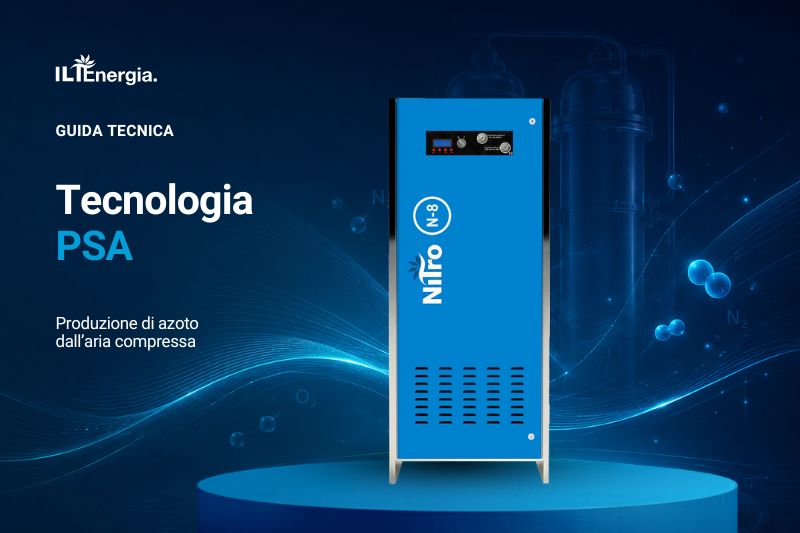
PSA technology for nitrogen production is one of the most widely used solutions for generating nitrogen from compressed air directly on-sit the purity level required by their process, reducing the costs and operational complexity associated with cylinders or liquid nitrogen deliveries while increasing production autonomy.
ILT Energia designs and manufactures on-site technical gas generation systems, including its Nitro Series industrial nitrogen generators, developed to provide companies with a reliable and controlled nitrogen supply directly at the point of use.
In our previous article, we explained how a nitrogen generator works and when on-site nitrogen production makes sense. In this article, we take a closer look at Pressure Swing Adsorption, how the process operates and why PSA has become a reference technology for a wide range of industrial applications.
What Is PSA Technology for Nitrogen Production?
PSA, or Pressure Swing Adsorption, is a gas separation process that extracts nitrogen from compressed air by exploiting the different adsorption properties of the molecules contained in it.
Atmospheric air consists of approximately 78% nitrogen, 21% oxygen and small quantities of argon, carbon dioxide and other gases.
Inside a PSA nitrogen generator, compressed air passes through an adsorbent material known as a Carbon Molecular Sieve, or CMS. This material selectively retains oxygen and other components of the air, while nitrogen continues through the system towards a buffer tank or directly to the production process.
It is important to distinguish between adsorption and absorption. During adsorption, molecules are retained on the surface of the adsorbent material rather than being absorbed into it. The technical meaning of this phenomenon is explained in the IUPAC definition of adsorption.
The result is a continuous and controlled nitrogen supply, with a purity level configured according to the requirements of the application.
How Does PSA Technology for Nitrogen Production Work?
Nitrogen production from compressed air takes place through an automatic cycle consisting of several stages.
1. Compressed Air Treatment and Filtration
Before entering the PSA system, compressed air must be properly treated.
Filters and dryers remove solid particles, condensation, oil vapours and other contaminants that could affect the performance and service life of the Carbon Molecular Sieve.
The quality of the inlet air is therefore essential for maintaining system efficiency, protecting the adsorbent material and ensuring consistent nitrogen quality.
2. Gas Separation and Nitrogen Production
Once filtered, the compressed air enters a vessel containing the Carbon Molecular Sieve.
During this stage, the CMS preferentially adsorbs oxygen molecules and other gases. Nitrogen molecules pass through the vessel and are directed towards a buffer tank or supplied directly to the production process.
The generator control system monitors the main operating parameters and verifies that the nitrogen produced meets the required quality level.
3. Automatic Regeneration of the Adsorbent Material
When the adsorbent material inside the first vessel reaches a certain level of saturation, the pressure is reduced.
Depressurisation releases the oxygen and other gases retained by the CMS, allowing the material to regenerate and prepare for a new production cycle.
The separated gases are discharged safely into the atmosphere.
4. Alternating PSA Vessels
A PSA nitrogen generator generally uses two adsorption vessels operating alternately.
While one vessel produces nitrogen, the other is depressurised and regenerated. Once regeneration is complete, the functions of the vessels are reversed.
This continuous alternation between adsorption and regeneration ensures a stable nitrogen flow without interrupting the production process.
The repeated variation in pressure gives Pressure Swing Adsorption its name and makes PSA an efficient, automatic and reliable technology for industrial nitrogen production.
Advantages of PSA Technology for Nitrogen Production
Installing a PSA nitrogen generator allows companies to produce gas directly where it is required, sizing the system according to the necessary flow rate, pressure and purity.
The main advantages of on-site nitrogen production include:
- continuous nitrogen production directly at the facility;
- reduced dependence on cylinders, cylinder bundles and liquid nitrogen deliveries;
- greater control over operating and supply costs;
- nitrogen purity adapted to the actual requirements of the process;
- fewer logistics activities related to gas delivery and cylinder replacement;
- reduced need for gas storage;
- increased production autonomy;
- lower risk of supply interruptions;
- automated system operation;
- planned and predictable maintenance;
- improved control over gas availability and consumption.
The economic benefits of a nitrogen generator should be evaluated by considering actual nitrogen consumption, required purity, operating hours and current gas supply costs.
Nitro Series PSA Nitrogen Generators by ILT Energia
ILT Energia’s Nitro Series nitrogen generators use PSA technology to produce nitrogen directly from compressed air.
The system is designed to provide a continuous gas flow and monitor the purity of the nitrogen produced, giving companies greater control over both the production process and gas availability.
Different configurations are available depending on parameters such as:
- average nitrogen consumption;
- maximum flow rate;
- required operating pressure;
- required purity level;
- production continuity;
- compressed air system characteristics;
- available installation space;
- industrial sector and application;
- possible future expansion of the system.
ILT Energia supports customers during the analysis of their production requirements and the selection of the most suitable configuration.
The objective is not simply to supply a nitrogen generator, but to integrate the system correctly into the existing plant, optimise on-site production and ensure that the generator meets the actual requirements of the process.
Industrial Applications of PSA Nitrogen Production
PSA technology is used in many industrial sectors requiring a continuous and controlled nitrogen supply.
Food and Packaging Industry
Nitrogen is used in modified atmosphere packaging, tank and container inerting and processes where products must be protected from contact with oxygen.
By reducing oxygen exposure, nitrogen can help preserve product characteristics and support the required packaging conditions.
Pharmaceutical Industry
In pharmaceutical production, nitrogen can be used to inert equipment and process environments, protect substances that are sensitive to oxidation and maintain controlled atmospheres during specific production stages.
Laser Cutting and Metalworking
Nitrogen is frequently used as an assist gas in laser cutting, particularly when the process requires clean edges and reduced oxidation of the material.
The required nitrogen purity and pressure depend on the material, thickness and cutting technology being used.
Electronics Manufacturing
In the electronics industry, nitrogen is used to create controlled atmospheres during soldering, component manufacturing and other processes involving materials that are sensitive to oxygen.
Chemical Industry
Nitrogen is commonly used for the inerting and blanketing of tanks, pipelines and reactors, helping maintain controlled process conditions and limit contact with oxygen.
Automotive and Metal Component Production
In the automotive and metalworking sectors, nitrogen is used in heat treatment, laser processing, component manufacturing and other applications requiring low-oxygen or controlled atmospheres.
Further information on possible uses is available in the section dedicated to ILT Energia industrial applications.
How to Choose a PSA Nitrogen Generator
Selecting a nitrogen generator should not be based exclusively on the maximum quantity of nitrogen the system can produce.
Correct system sizing requires an analysis of several parameters:
- average nitrogen consumption;
- peak demand;
- required nitrogen purity;
- operating pressure;
- daily and annual operating hours;
- compressed air quality and availability;
- existing buffer tanks;
- expected pressure drops;
- continuity requirements;
- possible future increases in demand.
Nitrogen purity is one of the most important factors to evaluate.
Requesting a higher purity than the process actually needs can increase compressed air and energy consumption, reducing the overall efficiency of the system. The generator should therefore be configured according to the real operating requirements rather than the highest technically achievable purity.
A technical assessment makes it possible to identify the correct balance between gas purity, flow rate, energy consumption and investment cost.
Frequently Asked Questions About PSA Technology
What is PSA technology?
PSA, or Pressure Swing Adsorption, is a gas separation technology used to produce nitrogen from compressed air. An adsorbent material selectively retains oxygen and other gases, allowing nitrogen to pass through the system.
How does a PSA nitrogen generator work?
A PSA nitrogen generator generally uses two vessels containing Carbon Molecular Sieve. One vessel produces nitrogen while the other regenerates. The vessels alternate automatically to provide a continuous gas supply.
What nitrogen purity can be achieved?
The achievable purity depends on the generator configuration, flow rate and requirements of the production process. PSA systems can produce nitrogen at very high purity levels, potentially reaching up to 99.999% in suitable configurations.
What are the advantages of producing nitrogen from compressed air?
Producing nitrogen from compressed air reduces dependence on external suppliers, simplifies logistics, decreases gas storage requirements and ensures a continuous supply directly at the point of use.
Can a PSA nitrogen generator completely replace cylinders?
In many industrial applications, it can, provided that the generator is correctly sized according to nitrogen consumption, pressure, purity and peak demand.
The decision should be based on a technical and economic assessment of the specific production process.
Does a PSA nitrogen generator require a compressed air system?
Yes. Compressed air is the raw material used by the PSA process. It must be supplied at the correct pressure, flow rate and quality to protect the Carbon Molecular Sieve and ensure reliable nitrogen production.
Is nitrogen purity adjustable?
Yes. The operating configuration of a PSA nitrogen generator can be adapted to provide the purity required by the application. However, higher purity generally affects nitrogen output and compressed air consumption, so the system should be configured carefully.
Why Choose On-Site Nitrogen Production?
PSA technology for nitrogen production provides an efficient and reliable solution for companies that want to generate nitrogen directly at their facility.
By using Pressure Swing Adsorption, businesses can obtain a continuous and controlled nitrogen supply, reduce dependence on external deliveries and integrate gas generation into their production process.
ILT Energia’s Nitro Series generators are designed for different industrial applications and can be configured according to the required flow rate, pressure and purity.
Are you considering installing a PSA nitrogen generator?
Discover ILT Energia’s Nitro Series nitrogen generators or contact the ILT Energia team to analyse your nitrogen consumption and identify the most suitable solution for your production process.