
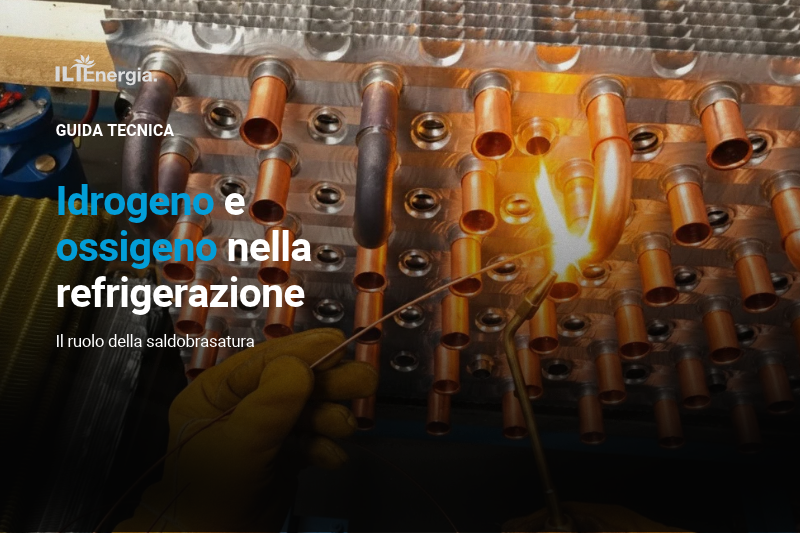
In refrigeration and air conditioning systems, the quality of joints plays an important role in the reliability of the entire system. Pipes, fittings, coils and heat exchangers require precise processing, particularly when copper components are involved.
One of the processes used to create these joints is brazing, where the choice of heat source and the gases used to generate the flame can directly affect process control. We have already explored this topic in our article on brazing with hydrogen and oxygen.
In this context, the use of hydrogen and oxygen in refrigeration represents an interesting industrial application: the two gases can be used to generate a flame suitable for brazing copper pipes and components.
Where are hydrogen and oxygen used in refrigeration?
When discussing hydrogen and oxygen in the refrigeration and HVAC sector, we are not referring to the refrigerant gases circulating inside the system.
H₂ and O₂ are used during manufacturing or assembly processes, particularly to generate the flame required for brazing operations.
Applications may include copper pipes and fittings, coils, heat exchangers and other components requiring brazed joints.
This application was also investigated within the European SAFEFLAME project, which focused on the development of oxy-hydrogen flame technology for welding, cutting and brazing. The project included tests on refrigeration-grade copper pipes as well as components such as coils and pipework, comparing oxy-hydrogen technology with conventional systems.
Why use a hydrogen-oxygen flame?
Brazing requires the filler material to reach the temperature necessary to create the joint without melting the components being joined.
For this reason, having a stable and controllable flame, suited to the material and characteristics of the component, is particularly important.
The use of hydrogen and oxygen makes it possible to generate a clean and adjustable flame. Hydrogen combustion mainly produces water vapour and can help limit residues in the working area.
In industrial applications, flame control becomes especially relevant when the same process must be repeated across large numbers of components while maintaining consistent operating conditions.
ILT Energia uses gases produced by its Elite Series hydrogen and oxygen generators for metal brazing operations, both in manual applications and automated systems. Further examples can also be found in our industrial applications.
Brazing copper pipes in refrigeration systems
Copper is widely used in refrigeration and air conditioning systems, and its brazing requires careful control of heat input.
Excessive heating can affect the component, while inadequate heat distribution can influence the quality of the joint.
The work carried out within the SAFEFLAME project is particularly relevant in this respect. Tests included copper pipes specifically intended for refrigeration applications. A burner developed during the project proved effective on refrigeration-grade copper pipes up to 28 mm in diameter, extending to 32 mm with appropriate operating practice.
According to the mechanical tests reported by the project, samples brazed using oxy-hydrogen also achieved results comparable to those obtained with acetylene and propane under specific test configurations.
This does not mean that there is a universal solution for every application. Component size and geometry, materials, filler material, gas flow rates and flame characteristics must all be evaluated according to the specific process.
From gas cylinders to on-site H₂ and O₂ production
When brazing is a continuous part of the manufacturing process, another factor becomes important alongside flame quality: how hydrogen and oxygen are supplied.
One option is to produce both gases directly at the production facility using an on-site generator.
ILT Energia’s Elite Series generators produce hydrogen and oxygen through water electrolysis, maintaining the two gas streams separate. The systems are designed for both manual and automated brazing applications.
On-site production therefore makes it possible to integrate gas generation directly into the manufacturing process, configuring the system according to actual production requirements.
When should an H₂/O₂ generator be considered for refrigeration applications?
Not all refrigeration and HVAC applications have the same requirements.
When evaluating the integration of an on-site gas generation system, several factors should be considered, including the number of workstations, whether brazing is manual or automated, component dimensions and materials, required gas consumption and production continuity.
For this reason, generator sizing should not simply begin with the selection of a particular model. It should start with an analysis of the application and the manufacturing process.
Hydrogen and oxygen: a practical application in the HVAC industry
The use of hydrogen and oxygen in refrigeration is therefore closely linked to the brazing operations required to manufacture and assemble pipes and components.
For companies carrying out these processes continuously, on-site H₂ and O₂ production can be considered as a way of integrating gas availability directly into the production cycle.
ILT Energia has been designing and manufacturing technical gas generation systems for over forty years and develops H₂/O₂ solutions configured according to the requirements of each application.
→ Discover ILT Energia Elite Series hydrogen and oxygen generators
→ Contact ILT Energia to discuss your application