
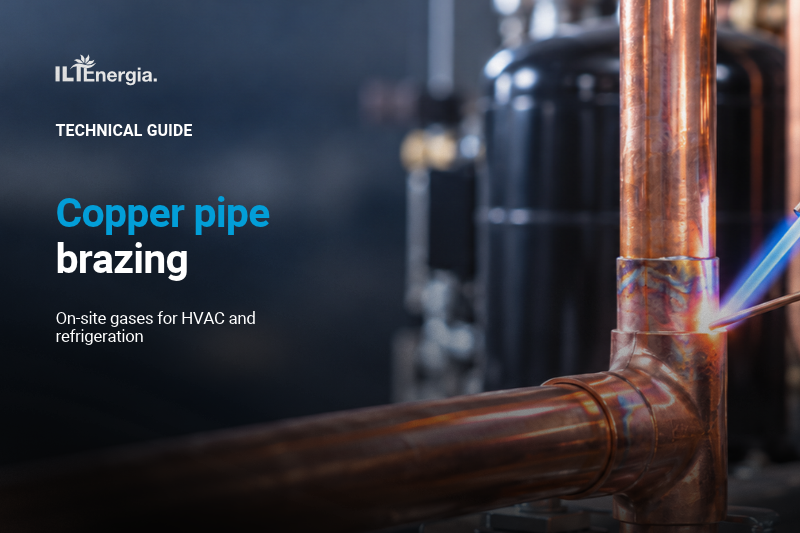
Copper pipe brazing is part of the manufacture and assembly of piping and components for HVAC and refrigeration equipment. In facilities producing chillers, heat pumps, heat exchanger coils and heat exchangers, these operations may be repeated across several workstations throughout the day.
In this setting, gas management is part of production planning: how gases are supplied, where they are stored and how many workstations need to be supplied at the same time.
On-site hydrogen and oxygen generation addresses these requirements by providing a gas source configured around the actual needs of the production line.
Copper pipe brazing: from the workstation to the production line
Manufacturing chillers, condensers, evaporators and heat exchanger coils involves numerous brazing operations. Requirements can vary between manual workstations, semi-automatic lines and automated systems.
Assessing the gas supply therefore means looking beyond an individual workstation. The number of users, their consumption and simultaneous operation all need to be considered.
For an overview of the technology, read our article on hydrogen and oxygen brazing. Here, we focus on integrating gas production into the facility and the factors to assess before selecting a system.
Hydrogen and oxygen produced directly on-site
ILT technology uses demineralised water and electricity to produce hydrogen and oxygen through electrolysis.
The two gases are produced separately in the electrolytic cell and supplied to the workstations through the production and distribution system specified for the installation.
The gas source becomes part of the manufacturing process, reducing reliance on external supply. Depending on the requirements of the line, a centralised configuration can also be considered to supply several workstations.
Explore the available solutions in our Elite Series hydrogen and oxygen generators range.
Fewer cylinders to store and handle
In facilities with several brazing stations, cylinder management involves deliveries, storage, internal handling and changeovers.
On-site generation reduces the need to maintain large stocks of fuel gas in cylinders, limiting the activities associated with handling and replacing them.
Reducing stored quantities can play an important role in fire and explosion risk prevention and management. It does not, however, eliminate every risk: H₂/O₂ production and use still require system design, installation, distribution and operation that comply with the applicable safety requirements.
Copper pipe brazing: costs beyond the cylinder
Assessing the economic benefits of on-site generation requires more than a comparison with the purchase price of gas.
Cylinder supply also involves transport, delivery, administration, internal handling, storage and changeover costs. These need to be considered together, particularly when gas is used across several workstations.
For on-site generation, the comparison includes investment in the generator, electricity, demineralised water and maintenance.
There is no standard saving that applies to every company. The assessment depends on consumption, operating hours, logistics, geographical location and supply terms. The relevant measure is the total cost of gas management, not just the price of a cylinder.
Sizing the gas supply for copper pipe brazing
Generator selection should start with the needs of the production line. Knowing how many workstations are installed is not enough: it is also necessary to understand how many operate at the same time.
The main factors to assess are:
- required hydrogen and oxygen flow rates
- number of workstations and simultaneous demand
- pressure and operating conditions
- actual gas consumption and operating hours
The ILT range allows gas production to be configured for one or more workstations according to the required flow rate. Final model selection must take the operating conditions of the specific line into account.
This assessment helps define the gas supply requirements and develop a facility-specific cost comparison, rather than relying on generic consumption figures.
On-site generation and sustainability
Electrolysis uses water and electricity. Integrating electricity from renewable sources can support efforts to reduce the environmental impact of gas production.
Sustainability therefore sits alongside the other factors to assess: gas stocks, costs and the organisation of the production line.
A gas source designed around your production line
For copper pipe brazing in HVAC and refrigeration manufacturing, the starting point is the process itself: which workstations need gas, how much they consume and under what operating conditions.
ILT Energia configures on-site H₂/O₂ production around the requirements of brazing lines. ILT’s experience in the sector dates back to 1980 and includes more than 3,000 electrolysers installed worldwide.
Are you considering on-site gas generation for a production line manufacturing chillers, heat exchanger coils or heat exchangers? Contact ILT Energia to discuss gas consumption, workstations and system configuration.